
Private Tailoring

Updated: Feb 23

The Return of Discretion in Modern Luxury
Private tailoring is precision without politics.
Private tailoring is the highest expression of bespoke tailoring—a discreet, appointment-led bespoke service in which garments are created through individual measurements, pattern drafting, and final fitting rather than selected from a shop floor. Not fashion. It is structure, precision, and craftsmanship delivered with exceptional service to the modern man whose life demands discretion and impeccable fit. A man learns early what matters when the world turns rough.
In a boardroom it might be the pause before an answer. In the bush it might be the sound a boot makes on dry ground. Somewhere between the two, he comes to understand that standards are not decoration. They are weapons.
Tailoring was once part of that armoury. Quiet, precise, almost anonymous. A cutter would take your measure in a room where voices stayed low. Cloth would be unrolled like a chart. Chalk would mark decisions that could not be explained to an audience because there was no audience. You left with nothing to show for it except the certainty that something had been set in motion.
Then luxury became noisy. Shop floors grew bright and eager. Mirrors multiplied. The language changed. It began to speak of novelty, of drops, of seasons, of what was “in.” Men were shepherded through racks as if choosing a suit were a form of entertainment. A certain kind of client walked away from that.
A client that did not seek a vast range of clothes displayed beneath bright lights. He sought a refined bespoke service where cloth selection, fabric quality, and precise measurements were considered with the utmost care—where garments were crafted rather than peddled, and where the suit would fit flawlessly because it had been created specifically for him.
He did not announce his reasons. He simply stopped participating.
Private tailoring has returned because men of that calibre never needed the theatre. They sought the result.
What Private Tailoring Looks Like in Practice—A Discreet Bespoke Service
Private tailoring is a service conducted away from the shop floor. The tailor comes to you. A private residence. An office. A hotel suite before an evening event. A country house between obligations. The appointment is arranged with professional discretion, whether the client requires a first fitting for a made-to-measure suit, a final fitting before a special occasion, or alterations to jackets, trousers, shirts, or even jeans that must complement the structure of his existing wardrobe. The appointment is arranged to fit into the principal’s day without forcing the day to rearrange itself around the appointment.
That sounds like convenience. It is, but the deeper advantage sits elsewhere.
In private, the client is not being sold to.
He is not treated as a customer in a shop. He is treated as a principal whose clothing must reflect personality, individuality, and his messaging—whose garments must define his presence in the world without appearing performative.
He stands in his own light, in the room he knows, where his posture is natural. He moves the way he does when no one is watching him perform. That matters, because posture is not a pose. It is the body’s history, written in the shoulders and the spine.
A competent tailor reads that history with command.
A fitting begins with measurement, but goes far beyond just that. The jacket must be drafted for a shoulder that slopes a fraction more on one side. The sleeve must be set for the way the bearer’s arms hang when he speaks naturally. The balance of the coat must account for whether he stands forward in the chest or carries weight back through the hips. These are not mere refinements. They are fundamentals.
A ready-made jacket is drafted for symmetry on a hanger. A tailored jacket is drafted for asymmetry in motion.
Tailoring is closer to anatomy than to fashion. It resembles the sculpting of Michelangelo’s David—an understanding not only of proportion, but of how muscle and bone behave beneath the surface. The cutter must account for how the body turns, reaches, sits, and stands. Cloth must anticipate life.
A garment that ignores them looks wrong in motion. It rides up at the collar. It rifts across the back. It creases where it should drape cleanly. It makes the wearer adjust himself, and every adjustment tells the room a story the man never intended to tell. Without this foundation of craftsmanship and innovation, a made-to-measure service cannot produce garments that fit perfectly whilst maintaining durability and elegance over years of wear. Private tailoring exists to ensure this.
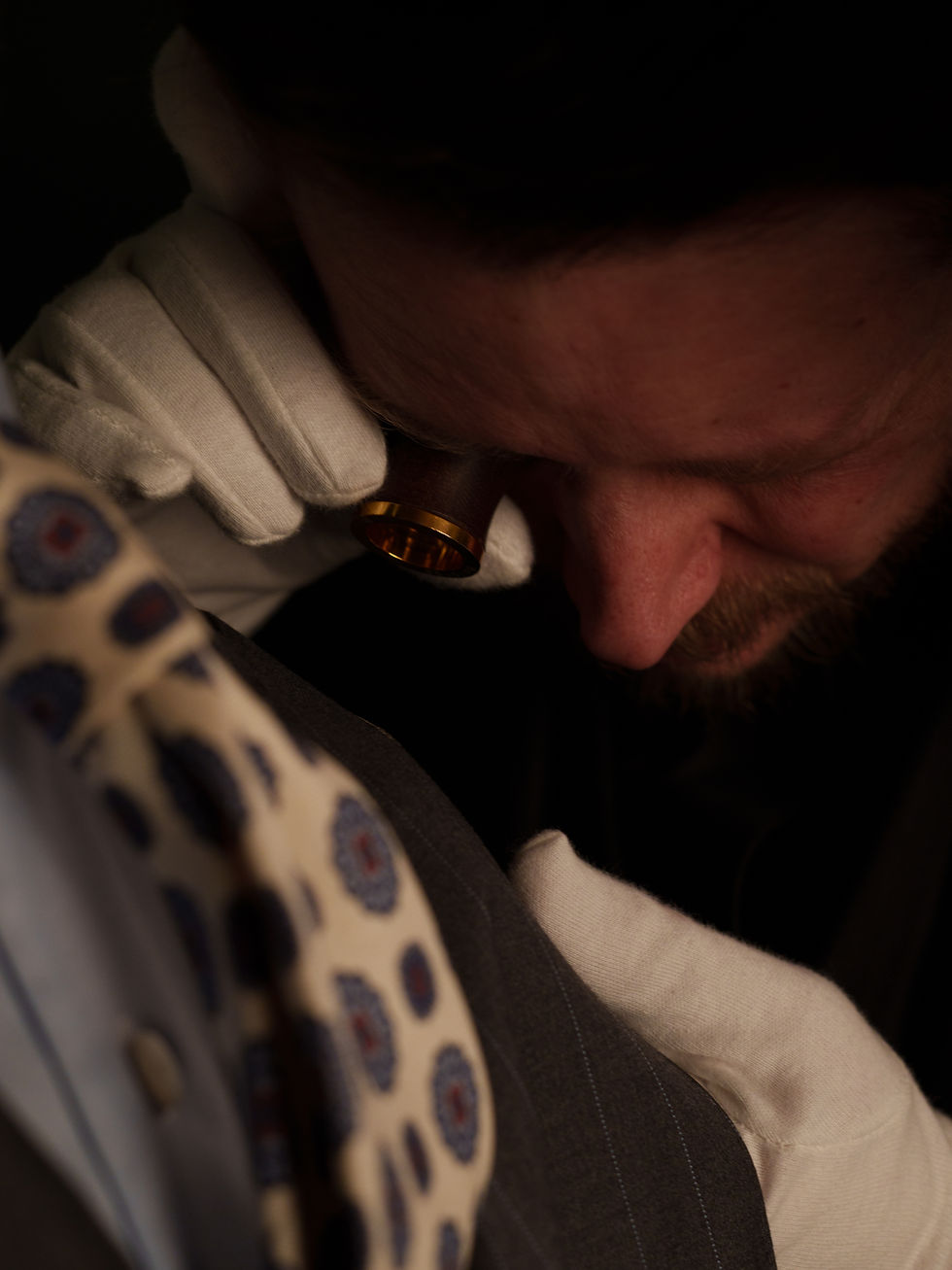
The Difference Between a Suit That Fits and One That Behaves
Off-the-rack suits are drafted to an average that belongs to no one. Fused chest pieces destined to ripple with heat and time. Canvassing replaced by adhesive. Structure sacrificed for speed. These garments assume standard proportions, then rely on quick alterations to disguise the mismatch. Hem the trouser. Take in the waist. Shorten the sleeve. It gives a man a suit that fits on paper. This is clothing produced for volume fashion—not bespoke suits created through private tailoring, where structure, fabric, linings, and construction are considered individually for each client.
Made-to-measure and bespoke begin where those shortcuts end.
A proper fitting originates at the shoulder line—the suit’s postural anchor. If the shoulder is wrong, the rest becomes a compromise. The tailor studies the client standing still, then in motion. He perfects the pitch of the sleeve, because sleeve pitch decides whether a jacket feels like a uniform or like armour. He scrutinises the coat balance, because balance determines whether the garment hangs cleanly or fights the body.
A good cutter will note the small things most men cannot name: a stooped posture, a dropped shoulder, a prominent blade. Those details decide whether a jacket sits properly against the neck, whether the chest flows smoothly, whether the coat breaks clean at the waist.
This is why a private fitting matters. It ensures the suit does not simply fit—it fits perfectly, complementing posture, movement, and personal style without the need for constant adjustments.
A properly executed bespoke service creates garments with individual pattern blocks retained for future commissions, forming the foundation of a wardrobe built on precision rather than convenience.
It is conducted in the client’s reality. The garment is forged for that familiarity.

Discretion as a Form of Power
Discretion has become expensive.
There are men who cannot buy a coffee without being photographed. There are men whose name carries obligations across continents. There are men who keep their world intact by ensuring that certain things remain unobserved.
A private tailoring appointment respects that.
The service is delivered with absolute confidentiality, exceptional professionalism, and a level of premium service rarely encountered in modern luxury fashion.
No public consultations. No testimonials. No strangers within earshot. No shop assistants hovering, no bright sales patter, no pressure to decide quickly. Cloth is considered properly. The principal can pause without being hurried. He can reject a cloth without apology. He can ask for a detail to be changed without being told it will disrupt a collection.
The quiet is not a luxury extra. It is the condition under which the finest decisions are made.

Time, and the Cost of Wasted Decisions
A wardrobe can bleed time from a man in small cuts.
Shopping trips that achieve nothing. Online orders that arrive wrong. Alterations that fix one problem and create another. The endless low-grade irritation of garments that never sit exactly as they should.
Private tailoring reverses that pattern. Measurements are recorded with precision. Patterns are retained. Cloth selection becomes intentional rather than impulsive. The tailoring experience becomes efficient without sacrificing quality.
The tailor already knows how his shoulders sit, how his trousers should rise, how much room he needs to move without cloth billowing like a sail. The garments are crafted once, then refined over time—delivered consistently, altered when required, and evolved alongside the client’s life and business commitments.
Time returns to the client, not as a promise, but as a result. A compounding advantage that reveals itself over years.
Tailoring That Travels With the Life It Serves
Modern principals do not live in one place.
Their calendar transitions them across cities, climates, and roles. A suit that performs in the autumn of Mayfair does not perform in the heat of Nairobi. A jacket designed for boardroom posture may not suit travel days, when a man sits longer and moves through terminals. Their suits must transition between climates, boardrooms and weddings without losing structure or elegance.
Private tailoring adapts to that life.
Cloth weight is chosen for climate, not for fashion. Construction is selected for durability, not for showroom softness. Stress points are reinforced because a man who travels will strain a garment in different ways than a man who strolls from apartment to car.
A fitting carried out where the client lives gives the tailor information a shop cannot provide. The height of the desk chair. The way the client reaches for a phone. The shoes he actually wears. The habits that shape how cloth will behave.
A suit built with this knowledge lasts longer. It also looks right in the moments that matter—when cameras appear without invitation and a man has no time to adjust himself.

From Single Pieces to Wardrobe Architecture
The public conversation about private tailoring tends to obsess over the single suit. Most articles live and die on that.
A serious principal thinks beyond it.
He wants a wardrobe that functions. Not a mound of garments, each fighting the next. He wants cohesion.
He considers how bespoke shirts sit beneath jackets, how trousers break against an oxford shoe or a penny loafer, how garments created today will complement those commissioned years from now.
Private tailoring allows that cohesion to be designed from the beginning. Unlike standard made-to-measure services, true bespoke tailoring builds a wardrobe architecture over time, refining each tailored suit through successive commissions. Business pieces that share a consistent silhouette. Shirts that sit correctly under the jackets they were handmade for. Trousers that break properly on the shoe the client wears most, not the crisp shoe in a store.
When the wardrobe is designed as a system, decisions become fewer, the garments become finer. The client stops replacing garments that were never built for his life. He stops buying duplicates because nothing else quite works. He stops spending time patching over mistakes.
That is where the real value lies.
The House Perspective
Zouga & Wolf approaches private tailoring as a standard of service rather than an upgrade. Our service extends beyond the traditions of Savile Row whilst honouring its heritage—combining British craftsmanship with a traveling bespoke service delivered privately to clients across London, Manchester, and the wider world.
A consultation begins privately. Measurements are taken precisely and retained. Patterns are refined with each commission. Cloth is selected from established British and Italian mills whose fibres and finishes are built to last. Longevity is not a slogan; it is a technical property that begins with the right cloth and the right construction.
A genuine private tailoring service leaves a client with more than handmade garments.
It leaves him with an infrastructure: records, patterns, a relationship with craftsmen who understand his requirements, and garments built to be worn without collapsing.
This is how a wardrobe becomes something a man can rely on, the way he relies on a good watch or a well-made rifle. It does its job without asking for attention.
The Return of the Private Standard
Men with serious lives have always understood a quiet truth.
The best things rarely announce themselves.
Private tailoring is returning because it answers a need that never belonged to fashion cycles. It serves the client’s time. It respects his privacy. It delivers garments that behave correctly—in motion, in light, and under pressure.
When the world grows loud, the wise move in the opposite direction.
They choose what lasts.
Zouga & Wolf stands as Bespoke Outfitters—custodians of heritage, craftsmanship, and garments created to endure beyond the moment in which they are first worn.
Our private tailoring service operates discreetly across London, Manchester, and internationally, providing home, office, private aircraft, and hotel fittings for clients whose time and privacy are non-negotiable standards.
For those seeking private tailoring in the UK or abroad, consultations are arranged discreetly through the House upon request.


